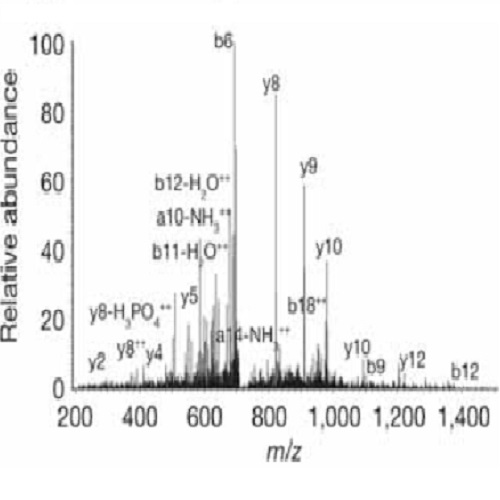
The position of the mitotic spindle controls the plane of cell cleavage and determines whether polarized cells divide symmetrically or asymmetrically. In animals, an evolutionarily conserved pathway of LIN-5 (homologues: Mud and NuMA), GPR-1/2 (homologues: Pins, LGN, AGS-3) and G? mediates spindle positioning, and acts downstream of the conserved PAR-3-PAR-6-aPKC polarity complex. However, molecular interactions between polarity proteins and LIN-5-GPR-G? remain to be identified. Here we describe a quantitative mass spectrometry approach for in vivo identification of protein kinase substrates. Applying this strategy to Caenorhabditis elegans embryos, we found that depletion of the polarity kinase PKC-3 results in markedly decreased levels of phosphorylation of a cluster of four LIN-5 serine residues. These residues are directly phosphorylated by PKC-3 in vitro. Phospho-LIN-5 co-localizes with PKC-3 at the anterior cell cortex and temporally coincides with a switch from anterior- to posterior-directed spindle movements in the one-cell embryo. LIN-5 mutations that prevent phosphorylation increase the extent of anterior-directed spindle movements, whereas phosphomimetic mutations decrease spindle migration. Our results indicate that anterior-located PKC-3 inhibits cortical microtubule pulling forces through direct phosphorylation of LIN-5. This molecular interaction between polarity and spindle-positioning proteins may be used broadly in cell cleavage plane determination.
Authors
Galli M, Muñoz J, Portegijs V, Boxem M, Grill SW, Heck AJ, van den Heuvel S