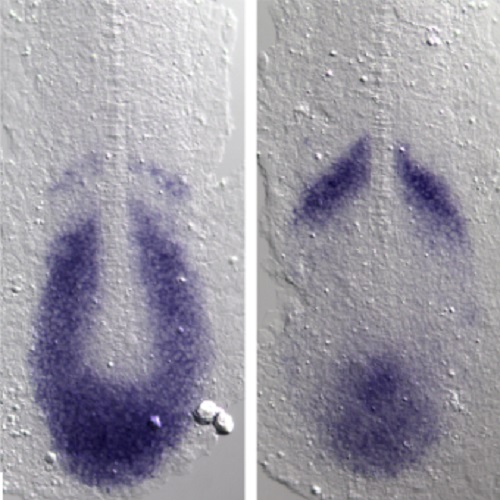
During vertebrate embryogenesis, the rhythmic and sequential segmentation of the body axis is regulated by an oscillating genetic network termed the segmentation clock. We describe a new dynamic model for the core pace-making circuit of the zebrafish segmentation clock based on a systematic biochemical investigation of the network's topology and precise measurements of somitogenesis dynamics in novel genetic mutants. We show that the core pace-making circuit consists of two distinct negative feedback loops, one with Her1 homodimers and the other with Her7:Hes6 heterodimers, operating in parallel. To explain the observed single and double mutant phenotypes of her1, her7, and hes6 mutant embryos in our dynamic model, we postulate that the availability and effective stability of the dimers with DNA binding activity is controlled in a "dimer cloud" that contains all possible dimeric combinations between the three factors. This feature of our model predicts that Hes6 protein levels should oscillate despite constant hes6 mRNA production, which we confirm experimentally using novel Hes6 antibodies. The control of the circuit's dynamics by a population of dimers with and without DNA binding activity is a new principle for the segmentation clock and may be relevant to other biological clocks and transcriptional regulatory networks.
Authors
Schröter C, Ares S, Morelli LG, Isakova A, Hens K, Soroldoni D, Gajewski M, Jülicher F, Maerkl SJ, Deplancke B, Oates AC
Research Area
Developmental Biology