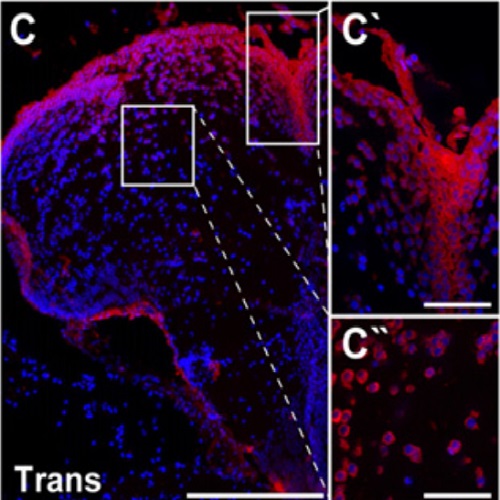
Zebrafish brains can regenerate lost neurons upon neurogenic activity of the radial glial progenitor cells (RGCs) that reside at the ventricular region. Understanding the molecular events underlying this ability is of great interest for translational studies of regenerative medicine. Therefore, functional analyses of gene function in RGCs and neurons are essential. Using cerebroventricular microinjection (CVMI), RGCs can be targeted efficiently but the penetration capacity of the injected molecules reduces dramatically in deeper parts of the brain tissue, such as the parenchymal regions that contain the neurons. In this report, we tested the penetration efficiency of five known cell-penetrating peptides (CPPs) and identified two- polyR and Trans - that efficiently penetrate the brain tissue without overt toxicity in a dose-dependent manner as determined by TUNEL staining and L-Plastin immunohistochemistry. We also found that polyR peptide can help carry plasmid DNA several cell diameters into the brain tissue after a series of coupling reactions using DBCO-PEG4-maleimide-based Michael's addition and azide-mediated copper-free click reaction. Combined with the advantages of CVMI, such as rapidness, reproducibility, and ability to be used in adult animals, CPPs improve the applicability of the CVMI technique to deeper parts of the central nervous system tissues.
Authors
Kizil C, Iltzsche A, Thomas AK, Bhattarai P, Zhang Y, Brand M