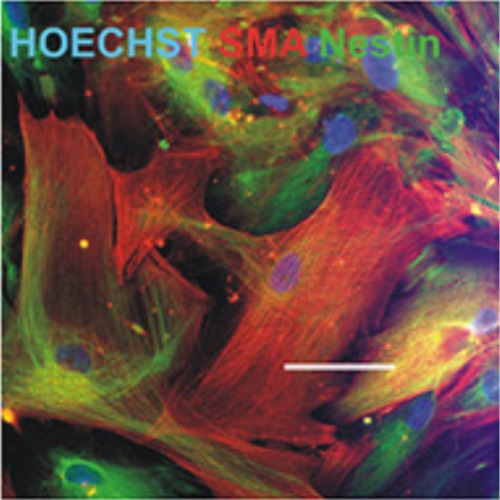
Brain perivascular cells have recently been identified as a novel mesodermal cell type in the human brain. These cells reside in the perivascular niche and were shown to have mesodermal and, to a lesser extent, tissue-specific differentiation potential. Mesenchymal stem cells (MSCs) are widely proposed for use in cell therapy in many neurological disorders; therefore, it is of importance to better understand the "intrinsic" MSC population of the human brain. We systematically characterized adult human brain-derived pericytes during in vitro expansion and differentiation and compared these cells with fetal and adult human brain-derived neural stem cells (NSCs) and adult human bone marrow-derived MSCs. We found that adult human brain pericytes, which can be isolated from the hippocampus and from subcortical white matter, are-in contrast to adult human NSCs-easily expandable in monolayer cultures and show many similarities to human bone marrow-derived MSCs both regarding both surface marker expression and after whole transcriptome profile. Human brain pericytes showed a negligible propensity for neuroectodermal differentiation under various differentiation conditions but efficiently generated mesodermal progeny. Consequently, human brain pericytes resemble bone marrow-derived MSCs and might be very interesting for possible autologous and endogenous stem cell-based treatment strategies and cell therapeutic approaches for treating neurological diseases.
Authors
Lojewski X, Srimasorn S, Rauh J, Francke S, Wobus M, Taylor V, Araúzo-Bravo MJ, Hallmeyer-Elgner S, Kirsch M, Schwarz S, Schwarz J, Storch A, Hermann A