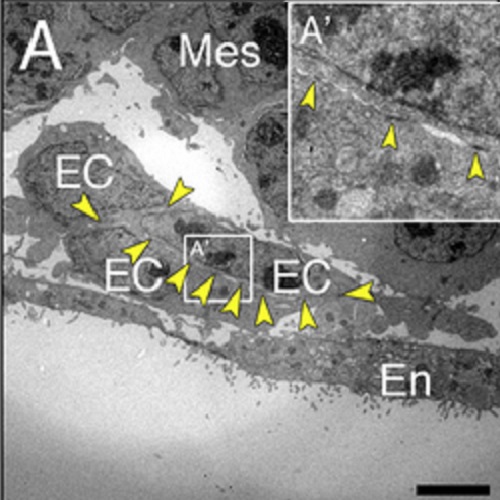
In vertebrates, endothelial cells (ECs) form blood vessels in every tissue. Here, we investigated vascular lumen formation in the developing aorta, the first and largest arterial blood vessel in all vertebrates. Comprehensive imaging, pharmacological manipulation, and genetic approaches reveal that, in mouse embryos, the aortic lumen develops extracellularly between adjacent ECs. We show that ECs adhere to each other, and that CD34-sialomucins, Moesin, F-actin, and non-muscle Myosin II localize at the endothelial cell-cell contact to define the luminal cell surface. Resultant changes in EC shape lead to lumen formation. Importantly, VE-Cadherin and VEGF-A act at different steps. VE-Cadherin is required for localizing CD34-sialomucins to the endothelial cell-cell contact, a prerequisite to Moesin and F-actin recruitment. In contrast, VEGF-A is required for F-actin-nm-Myosin II interactions and EC shape change. Based on these data, we propose a molecular mechanism of in vivo vascular lumen formation in developing blood vessels.
Authors
Strilić B, Kucera T, Eglinger J, Hughes MR, McNagny KM, Tsukita S, Dejana E, Ferrara N, Lammert E